So it's a bit too cold to spend Valentine's Day in most regions of Eastern Europe. That doesn't mean, however, that spending a romantic holiday in Eastern Europe shouldn't be saved for more temperate weather. Romance abounds in Eastern Europe - that is, depending upon your tastes.
I, for one, wouldn't mind a Moscow tour that included museums dedicated to Moscow's most famous authors, like Gogol, Tolstoy, or Pushkin. However, there are also other museums that showcase Kandinsky, Vrubel, and Faberge Eggs. Much of Moscow's romance is its history - the architecture, art, and royal relics make this ancient-yet-modern city irresitable.
Prague is considered one of Eastern Europe's most romantic cities, as well as its most beautiful. After all, its history can be found in Old Town, New Town, and Josefov. English speakers can get around easily and meet up with ex-pats that will tell them where the hot spots are.
Souvenirs from Eastern Europe make great romantic gifts. Poland's Kaniakow Village makes beautiful lace into lingerie. The Czech Republic is famous for its garnet jewelry. Russian antiques are lavish gifts most people only dream of owning. However, the experts over at two of my favorite sites, A la Vieille Russie and S.J.Phillips are willing to work with clientele who can afford their high-end jewelry and objects d'art. After all, what's a diamond ring compared to one of Faberge's many inspirations?
If these gifts are a little bit out of your price range or availability, you can give flowers. However, be sure to give an odd number of flowers. In Eastern Europe, even numbers of flowers are associated with funerals!
Wednesday, January 31, 2007

Friday, January 19, 2007
Eastern Europe's Gold
Amber, for me, has always been associated with my Eastern European ancestry. Lithuanian relatives sent amber necklaces as gifts; when I wore one to a recent gathering of local Lithuanians to celebrate Christmas Lithuanian style, they were immediately assured that I had some right to be there (despite the fact that I could only smile in confusion when they addressed me in Lithuanian).
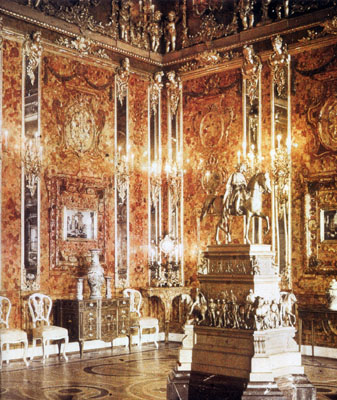
Amber is truly a symbol of Eastern Europe, especially the Baltic nations, on whose shores amber has washed up from the sea. In fact, there are even several amber museums in northern Eastern Europe dedicated to this glowing gem. When I was in Russia in 1994, the Amber Room at Catherine's Palace was just beginning to be restored from surviving photos. Now it has been fully restored, although the whereabouts of the original amber panels has not been discovered.
Amber has been primarily used in jewelry, but wearing it next to the skin requires special care to preserve its luminescence. Shopkeepers in Eastern Europe who have amber for sale will scold you if you touch any item on display. Today, much of the amber that appears in fashion jewelry in the West is made from pieces of amber that have been fused together. However, if you have a really nice piece of amber, you'll know it.
Amber is truly a symbol of Eastern Europe, especially the Baltic nations, on whose shores amber has washed up from the sea. In fact, there are even several amber museums in northern Eastern Europe dedicated to this glowing gem. When I was in Russia in 1994, the Amber Room at Catherine's Palace was just beginning to be restored from surviving photos. Now it has been fully restored, although the whereabouts of the original amber panels has not been discovered.
Amber has been primarily used in jewelry, but wearing it next to the skin requires special care to preserve its luminescence. Shopkeepers in Eastern Europe who have amber for sale will scold you if you touch any item on display. Today, much of the amber that appears in fashion jewelry in the West is made from pieces of amber that have been fused together. However, if you have a really nice piece of amber, you'll know it.
Subscribe to:
Posts (Atom)