What?! You haven't been to Ukraine Orphans yet? Get on over there! And buy a book while you're at it!
Conscience Calls: Proceeds go to the "Starving for Color" fund, which provides infant formula for Ukraine orphans.
Assumptions and Misunderstandings: Proceeds help at-risk Ukrainian children.
Photo Gallery by Michael Nakonachny: Purchase Forgotten Faces to help Ukraine orphans.
These books are history books, travel books, social commentaries, and works of love.
Sunday, July 01, 2007

Friday, June 01, 2007
The Slavophile Community
One perk of being a Slavophile is that it puts you in touch with other Slavophiles and lovers of Eastern Europe. Not only can you share interests, exchange reading material, and be understood where others cease to understand, but you are automatically a part of a community that practices hospitality and welcomes all members graciously.
Eastern Europeans are known for their hospitality. If you're a guest at a non-Eastern European friend's house, they might tell you where the towels are. An Eastern European will bring you a towel. Your friend will point you to the couch. The Eastern European will make sure you have a bed - even if it's the only one in the house, and they will take the couch. In many households in Eastern Europe, your admiration for a decorative object will mean you'll be taking it home with you. Slavophiles, as non-Eastern Europeans, know how awkward that can be(who wants to carry an antique samovar on a plane?), so they'll probably be more lax about this requirement of Slavic hospitality. However, in other areas, they'll be keen to emulate the warm welcomes practiced by their Eastern European mentors.
Eastern Europeans are naturally curious about non-Eastern Europeans. And Slavophiles are keen to find others interested in Eastern Europe. These two groups of people want to know more about you and are happy to share their knowledge in return. So don't be afraid to seek out others like yourself. You'll be rewarded and make new friends who will treat you with respect, humanity, and courtesy.
Eastern Europeans are known for their hospitality. If you're a guest at a non-Eastern European friend's house, they might tell you where the towels are. An Eastern European will bring you a towel. Your friend will point you to the couch. The Eastern European will make sure you have a bed - even if it's the only one in the house, and they will take the couch. In many households in Eastern Europe, your admiration for a decorative object will mean you'll be taking it home with you. Slavophiles, as non-Eastern Europeans, know how awkward that can be(who wants to carry an antique samovar on a plane?), so they'll probably be more lax about this requirement of Slavic hospitality. However, in other areas, they'll be keen to emulate the warm welcomes practiced by their Eastern European mentors.
Eastern Europeans are naturally curious about non-Eastern Europeans. And Slavophiles are keen to find others interested in Eastern Europe. These two groups of people want to know more about you and are happy to share their knowledge in return. So don't be afraid to seek out others like yourself. You'll be rewarded and make new friends who will treat you with respect, humanity, and courtesy.
Tuesday, April 24, 2007
Why Poland?
Poland is quickly becoming a popular tourist destination, as two other hotspots in Eastern Europe continue to encourage visitors. While Moscow is one of the world's great cities, its prices are skyrocketing - both for its residents and for travelers. Ever-trendy Prague is brimming with ex-pats and a multicultural mix; its status as an international destination is quickly becoming more established. This makes the cultural characters of the two most-traveled-to cities in Eastern Europe less accessible to the person seeking the "real" Eastern Europe.
But Poland, the Northern European nation that is set apart from its neighbors but still distinctly Slavic, is an Eastern European traveler's unexpected favorite. For one, it is a country that proudly maintains its heritage - from Easter traditions that include richly-decorated pisanki, to traditional wood-carved boxes and toys, Poland retains folk customs even though Polish lifestyles and tourist attractions are becoming steadily more sophisticated.
Poland's traditional cuisine, like mushroom- or potato-filled pierogi, can be found in colorful array at even fine dining establishments. Poland's hotel industry is aswarm with guests who want to stay at palace and castle hotels in the city, country, or by the sea.
Even if you can't go anytime soon, you can have a taste of Poland. Poland's has high standards for its historical vodka industry. Chopin is a personal favorite, but there are other brands of vodka available from Poland that are very good as well.
Other ways to express your interest in Poland is to volunteer in Poland, learn the Polish language, or get involved with a Polish association.
Polish American Association
The National Polish-American - Jewish-American Council
Polish-American Congress
Polish-American Historical Association
You may even pick up a Polish cookbook and try your hand at some of Poland's national dishes.
But Poland, the Northern European nation that is set apart from its neighbors but still distinctly Slavic, is an Eastern European traveler's unexpected favorite. For one, it is a country that proudly maintains its heritage - from Easter traditions that include richly-decorated pisanki, to traditional wood-carved boxes and toys, Poland retains folk customs even though Polish lifestyles and tourist attractions are becoming steadily more sophisticated.
Poland's traditional cuisine, like mushroom- or potato-filled pierogi, can be found in colorful array at even fine dining establishments. Poland's hotel industry is aswarm with guests who want to stay at palace and castle hotels in the city, country, or by the sea.
Even if you can't go anytime soon, you can have a taste of Poland. Poland's has high standards for its historical vodka industry. Chopin is a personal favorite, but there are other brands of vodka available from Poland that are very good as well.
Other ways to express your interest in Poland is to volunteer in Poland, learn the Polish language, or get involved with a Polish association.
Polish American Association
The National Polish-American - Jewish-American Council
Polish-American Congress
Polish-American Historical Association
You may even pick up a Polish cookbook and try your hand at some of Poland's national dishes.
Wednesday, January 31, 2007
Eastern European Valentine's Day
So it's a bit too cold to spend Valentine's Day in most regions of Eastern Europe. That doesn't mean, however, that spending a romantic holiday in Eastern Europe shouldn't be saved for more temperate weather. Romance abounds in Eastern Europe - that is, depending upon your tastes.
I, for one, wouldn't mind a Moscow tour that included museums dedicated to Moscow's most famous authors, like Gogol, Tolstoy, or Pushkin. However, there are also other museums that showcase Kandinsky, Vrubel, and Faberge Eggs. Much of Moscow's romance is its history - the architecture, art, and royal relics make this ancient-yet-modern city irresitable.
Prague is considered one of Eastern Europe's most romantic cities, as well as its most beautiful. After all, its history can be found in Old Town, New Town, and Josefov. English speakers can get around easily and meet up with ex-pats that will tell them where the hot spots are.
Souvenirs from Eastern Europe make great romantic gifts. Poland's Kaniakow Village makes beautiful lace into lingerie. The Czech Republic is famous for its garnet jewelry. Russian antiques are lavish gifts most people only dream of owning. However, the experts over at two of my favorite sites, A la Vieille Russie and S.J.Phillips are willing to work with clientele who can afford their high-end jewelry and objects d'art. After all, what's a diamond ring compared to one of Faberge's many inspirations?
If these gifts are a little bit out of your price range or availability, you can give flowers. However, be sure to give an odd number of flowers. In Eastern Europe, even numbers of flowers are associated with funerals!
I, for one, wouldn't mind a Moscow tour that included museums dedicated to Moscow's most famous authors, like Gogol, Tolstoy, or Pushkin. However, there are also other museums that showcase Kandinsky, Vrubel, and Faberge Eggs. Much of Moscow's romance is its history - the architecture, art, and royal relics make this ancient-yet-modern city irresitable.
Prague is considered one of Eastern Europe's most romantic cities, as well as its most beautiful. After all, its history can be found in Old Town, New Town, and Josefov. English speakers can get around easily and meet up with ex-pats that will tell them where the hot spots are.
Souvenirs from Eastern Europe make great romantic gifts. Poland's Kaniakow Village makes beautiful lace into lingerie. The Czech Republic is famous for its garnet jewelry. Russian antiques are lavish gifts most people only dream of owning. However, the experts over at two of my favorite sites, A la Vieille Russie and S.J.Phillips are willing to work with clientele who can afford their high-end jewelry and objects d'art. After all, what's a diamond ring compared to one of Faberge's many inspirations?
If these gifts are a little bit out of your price range or availability, you can give flowers. However, be sure to give an odd number of flowers. In Eastern Europe, even numbers of flowers are associated with funerals!
Friday, January 19, 2007
Eastern Europe's Gold
Amber, for me, has always been associated with my Eastern European ancestry. Lithuanian relatives sent amber necklaces as gifts; when I wore one to a recent gathering of local Lithuanians to celebrate Christmas Lithuanian style, they were immediately assured that I had some right to be there (despite the fact that I could only smile in confusion when they addressed me in Lithuanian).
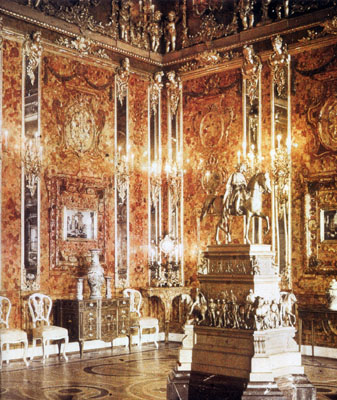
Amber is truly a symbol of Eastern Europe, especially the Baltic nations, on whose shores amber has washed up from the sea. In fact, there are even several amber museums in northern Eastern Europe dedicated to this glowing gem. When I was in Russia in 1994, the Amber Room at Catherine's Palace was just beginning to be restored from surviving photos. Now it has been fully restored, although the whereabouts of the original amber panels has not been discovered.
Amber has been primarily used in jewelry, but wearing it next to the skin requires special care to preserve its luminescence. Shopkeepers in Eastern Europe who have amber for sale will scold you if you touch any item on display. Today, much of the amber that appears in fashion jewelry in the West is made from pieces of amber that have been fused together. However, if you have a really nice piece of amber, you'll know it.
Amber is truly a symbol of Eastern Europe, especially the Baltic nations, on whose shores amber has washed up from the sea. In fact, there are even several amber museums in northern Eastern Europe dedicated to this glowing gem. When I was in Russia in 1994, the Amber Room at Catherine's Palace was just beginning to be restored from surviving photos. Now it has been fully restored, although the whereabouts of the original amber panels has not been discovered.
Amber has been primarily used in jewelry, but wearing it next to the skin requires special care to preserve its luminescence. Shopkeepers in Eastern Europe who have amber for sale will scold you if you touch any item on display. Today, much of the amber that appears in fashion jewelry in the West is made from pieces of amber that have been fused together. However, if you have a really nice piece of amber, you'll know it.
Sunday, October 15, 2006
Josefov - Prague's Jewish Ghetto
Eastern Europe and its Jewish inhabitants are inextricably linked over centuries of involvement. Josefov, or the Jewish ghetto in Prague, is one such example. Josefov's history began in medieval times, and visitors today can see relics of Josefov's past that include the Old Jewish Cemetery - which is a testament to Prague's Jewish population, the size of which had, at times, no rival in Europe. Up until the 19th century, stringent laws kept Jews in Josefov.
Many Jews in Central Europe were sent to the Terezin concentration camp. However, Jews all over Eastern Europe saw the inside of Terezin, Auschwitz-Birkenau, and other concentration camps.
Today, the relationship between Jews and their communities in Eastern Europe is still strained. Anti-Jewish sentiments run rampant in traditional communities. Even if a citizen is Jewish by heritage only, they may still be subject to discrimination and abuse.
Many Jews in Central Europe were sent to the Terezin concentration camp. However, Jews all over Eastern Europe saw the inside of Terezin, Auschwitz-Birkenau, and other concentration camps.
Today, the relationship between Jews and their communities in Eastern Europe is still strained. Anti-Jewish sentiments run rampant in traditional communities. Even if a citizen is Jewish by heritage only, they may still be subject to discrimination and abuse.
Thursday, September 07, 2006
Alfons Mucha - Forget "The Four Seasons"
Alfons Mucha is best known for his commercial art - posters of Sarah Bernhardt, The Four Seasons prints. These images have, for better or for worse, entered the popular consciousness as ideal for dormroom prints, stock decoration for cards and stationery, and even inspiration for tableware. But Mucha was much more than a graphic artist who sought to appeal to the world of marketing. The Czech painter was more interested in the spirituality of art, which is expressed most meaningfully in his existing non-commercial art.
Mucha's Slav Epic was intended to tell the history of the slavs in 20 enormous canvasses. This highly detailed series of paintings was nationalistic in nature and popular with the Prague locals. The Slav Epic scenes are, unfortunately, not exhibited at the Mucha Museum in Prague, even though Mucha considered them his masterpieces.
However, visitors to Prague can see his work in the stained glass windows of St. Vitus Cathedral. The historic cathedral, the most important in Prague, took 600 years to complete. If Mucha had been a lesser artist, it is doubtful that he would have a part of the construction of this iconic, historic structure.
Mucha's Slav Epic was intended to tell the history of the slavs in 20 enormous canvasses. This highly detailed series of paintings was nationalistic in nature and popular with the Prague locals. The Slav Epic scenes are, unfortunately, not exhibited at the Mucha Museum in Prague, even though Mucha considered them his masterpieces.
However, visitors to Prague can see his work in the stained glass windows of St. Vitus Cathedral. The historic cathedral, the most important in Prague, took 600 years to complete. If Mucha had been a lesser artist, it is doubtful that he would have a part of the construction of this iconic, historic structure.
Subscribe to:
Posts (Atom)